Field test and review
I have owned at least five sets of hiking poles over the years. My first pair was a $30 pair that I purchased on eBay. I had just started hiking and saw that a lot of more experienced hikers seemed to use them so I went and bought a pair, not truly understanding the benefits. I have since discovered that they are an invaluable part of your gear list when setting out on any bushwalk or hike. If you want to know more about the benefits and how to use poles I have provided a bit more info here.
Hiking poles provide experienced hikers and bushwalkers with a valuable aid to stability when negotiating steep descents and obstacles (creek crossings etc). Poles might engage the ground to the front, side or behind – together as a pair, or one at a time. Specific pole techniques in this mode are limited only by individual experience and imagination.
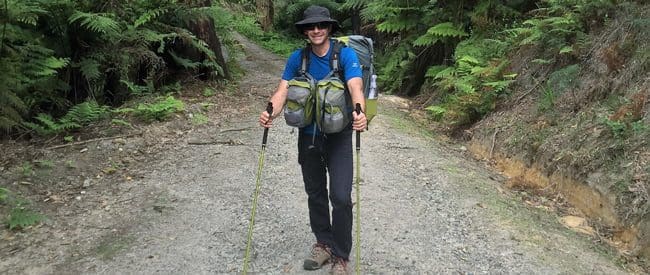
I have been using hiking poles on all of my hikes for several years now. Whether it be a day hike or multi-day pack carry I always find benefit in having my poles with me.
I was out hiking in Werribee Gorge one day and was tackling a few of the steeper spurs with my trusty $30 poles. On one long ascent I was leaning forward, putting all of my weight onto my hiking poles in order to ease the strain on my legs. One foot in front of the other I slowly made my way up the spur, carefully watching the placement of my poles on every step. I was about three quarters of the way through my ascent when my right pole struck the ground and conveniently buckled under me. I was fortunate that the pole didn’t pierce right through me as I crumbled to the ground. Needless to say that was the last time I ever used or recommended inferior gear.
So what do I use now? Over the past few months I have been testing out my new Helinox TL Series fixed length hiking poles. Since breaking my $30 pair I have always chosen to use fixed length poles due to their lighter weight and increased durability. There are no locking mechanisms to fail and no unnecessary lengths of pole that remain in the shaft of adjustable poles if you are not using their full length. The downside to adjustable poles I guess is that you don’t have the flexibility to adjust the height for ascents and descents or for a hiker’s individual height. Fixed length poles do come in a range of heights though and I have never considered this as a real negative as over uneven terrain the pole is always at odd angles to the ground.
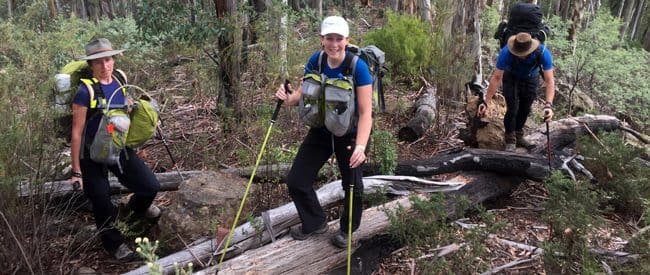
The Helinox TL Series new generation hiking poles are fixed length, ultra-lightweight, ultra-compact, strong and reliable. The TL series poles are suited for all general bushwalking, according to Helinox, but I have put them through their paces on many multi-day hikes and have found them to be suitable up to the task.
Out of the bag you simply undo the Velcro strap that has been ingeniously integrated into the pole (I love this feature) and the Helinox TL Series almost snap into place. Holding the hand grip and allowing the poles to drop towards the ground all you need to do is pull down on the upper part of the shaft and the three sections of pole snap into place with a quick lock mechanism. The pole is equipped with an ingenious folding mechanism which allows the poles to be quickly assembled and disassembled as required.
The Helinox TL Series poles are not lightest of all poles I have owned but at 312 grams per pair they certainly are a close contender. The pole sections are made from DAC TH72M alloy. As with all my field tests I believe that the proof is not in the marketing, but in the how gear performs in reality. Putting the TL Series to the test over sand, gravel, mud, river crossings and scrambling up and down rock faces I am pleased to say that they never once let me down. I was disappointed to have added a few scratches to the lower sections but they withstood the force of me with a 15kg pack bearing down on them for kilometres on end.
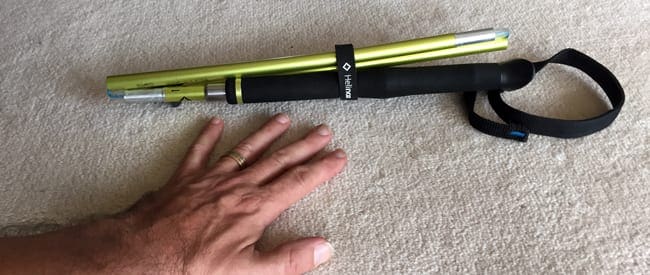
The collapsed poles are so small that they didn’t interfere with my movement when attached to my pack. In fact they are so small you could easily pop them into my 11kg day pack.
Comfort wise, the grip is made of foam which efficiently absorbed moisture from my sweaty hands, while still being soft to the touch. The size of the grip is well proportioned to be able to fit most hand sizes. I myself don’t rely on holding the grip too often though and only use this for support as most of my weight is placed firmly in the hand strap.
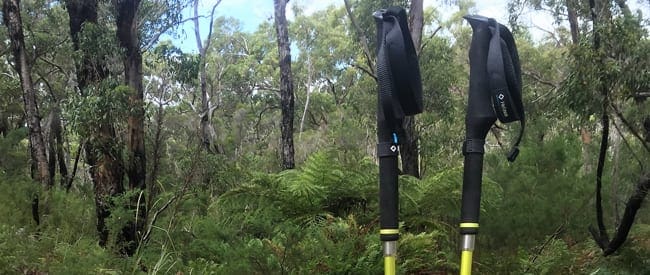
The padded straps are fully and easily adjustable, so easy in fact that you can do it whilst on the move. Of all the poles I have hiked with I found the TL Series to have the most user friendly adjustment mechanism. In general I found them very comfortable to wear although I have used poles that have a slightly wider and softer hand strap which offer increased comfort, particularly considering how much I rely on the straps. Yep, I have broken a few on other poles.
They are so light and so small that if you don’t need to use them you won’t even notice you have them in your pack.
Buy direct from Helinox from $156 per pair
RRP: from $198
Tech Specs
TL Series walking poles are available in a choice of three model sizes to suit different body heights:
- TL105 suits heights 145 to 165 cm.
- TL115 suits heights 160 to 180 cm.
- TL125 suits heights 175 to 195 cm.
TL Series Features:
- Super strength of exclusive DAC TH72M alloy – the world’s best.
- Ultra-lightweight for best performance.
- Simplest one press button operation.
- Quality foam grips with “wicking” wrist straps.
- Solidly mounted tungsten carbide tips.
- Rubber tip covers supplied – suited for pavement use.
- Supplied with operating instructions and hiking pole guidebook.
- Extremely compact for stowing – ideal for hikers who travel.
- The simplest, lightest and most compact hiking pole.
TL Series Operation:
- Tension lock (TL) mechanism secures “folding” sections together.
- Internal cord is tensioned as upper section is extended.
- Single button lock secures cord tension.
- Pole sections are physically “stacked” in series for immense strength.
- Button is depressed for instant tension release to fold and compact.
Read more at www.helinox.com.au
If you’re weighing up your next set of poles, weight and material are the two things I’d think about first. I consider a pair of poles lightweight once they come in under 400 grams, which is part of why I stuck with fixed length aluminium poles like the TL Series rather than moving to a heavier adjustable set. Aluminium can bend under high stress but is unlikely to break, and that matters more to me than the small weight saving carbon fibre offers, given carbon fibre poles are more prone to breakage or splintering in rugged, remote country.