Sorry, no records were found. Please adjust your search criteria and try again.
Sorry, unable to load the Maps API.
Hikes and walks in Churchill National Park
Here you’ll find every hike we list in Churchill National Park, Victoria. Each listing has the distance, grade and time it takes, so you can pick one that suits you. You can also search hikes across Australia.
Discover 3 hiking trails in Churchill National Park


Ridges, Granite Outcrops and Remnant Bushland at Churchill National Park
Overview
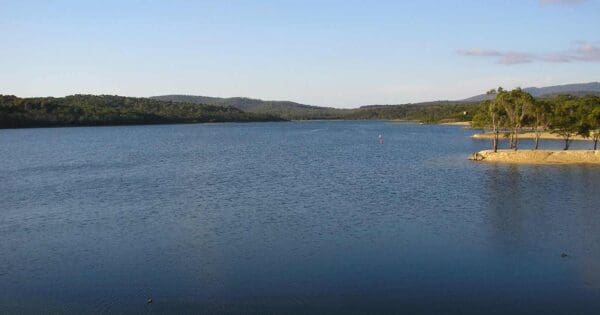
Churchill National Park protects a pocket of remnant bushland on Melbourne’s outer south-eastern edge, near Rowville. What makes it stand out is the sense of older country still holding on in a heavily settled part of Victoria. Woodland, forest and wetland habitats sit across the Lysterfield Hills, giving the park a much more rugged feel than its suburban setting might suggest.
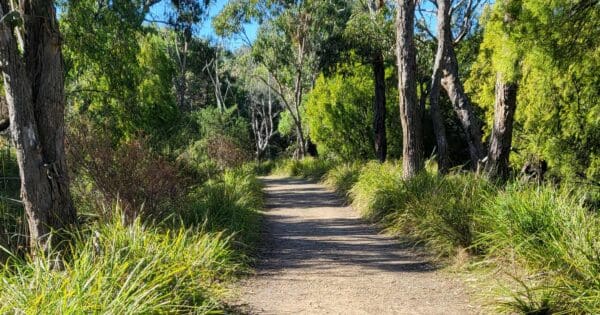
It is also a place where the original landscape before widespread clearing is still easy to picture. Much of the native vegetation has survived or regenerated across the hills, creeks and gullies, creating a park known as much for its wildlife as for its bush setting.
Highlights
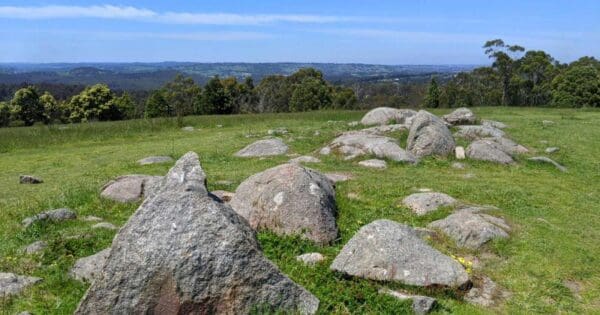
The park’s strongest natural feature is its hilly terrain. Ridges, spurs and exposed granite create a landscape with a rocky, dry-country character in places, while lower gullies and creek lines soften into denser vegetation. From higher ground, there are broad views towards the Dandenong Ranges, the surrounding foothills and parts of south-east Melbourne.
That mix of open slopes, bushland and lookouts gives Churchill National Park a varied feel for a relatively compact park. It is not about one dramatic landmark so much as the contrast between rocky high points, quieter creek flats and the sense of space that opens up along the ridgelines.
Best Time to Visit
Spring is a particularly appealing time to be here, when wildflowers begin to appear across the park. The warmer months also suit people who enjoy drier tracks and longer daylight, while the tree cover brings welcome shade through summer.
Winter has its own atmosphere, with cold mornings and occasional frost giving the hills a sharper, quieter feel. There is no single season that defines Churchill National Park, but spring and the milder parts of autumn tend to show the landscape at its most comfortable and varied.
Plants and Animals
Despite its suburban fringe location, the park supports a rich spread of native life. The broader Churchill and Lysterfield area has recorded more than 200 native species, including 27 mammal species and 172 bird species. Eastern grey kangaroos are especially well known here, and other mammals recorded in the area include koalas, platypus and black wallabies.
Birdlife is one of the park’s real strengths. Powerful owls, Swift Parrots and wedge-tailed eagles are among the notable species recorded, alongside a wide mix of bush birds and waterbirds. The vegetation is equally varied, with heathy woodland, herb-rich forest, riparian forest, swamp scrub and damp sclerophyll forest all represented. Native orchids occur here as well, including orange-tip caladenia and copper beard-orchid.
Culture and Heritage
Churchill National Park is part of an Aboriginal cultural landscape in the traditional Country of the Bunurong People. The park also holds evidence of more recent land use, including quarrying and firewood cutting in the 1920s and 1930s, with traces of a former rock crushing plant near Stonemasons Track.
Older layers of local history extend beyond that industrial use. Across the wider park area there are links to early farming, orchards, aqueduct construction and other settled landscapes that shaped the hills before they were protected.
Find more places to explore…
Help expand the trail collection!
Know of an official trail not listed on Trail Hiking Australia? I’m focused on showcasing the best tracks managed by land managers, and I’d love your help! Sharing a trail adds to our community and helps others discover safe, new adventures.
Submit your trail here