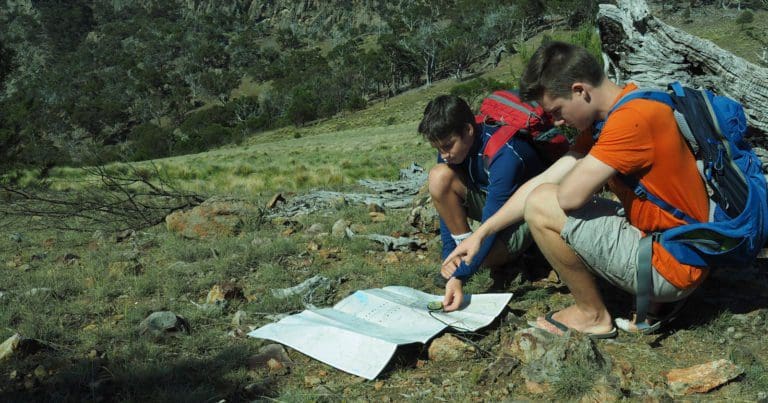
Following a marked trail feels straightforward. Coloured triangles on trees, posts at junctions, occasional arrows pointing the way. In many parts of Australia, these markers are clear and well maintained. But experienced hikers know something important. Trail markers support navigation. They do not replace it.
Tracks fade. Pads appear. Markers go missing. Old routes linger long after they are officially closed. In poor visibility or dense vegetation, the line of travel can become unclear even when markers exist. This article sits within the Navigation and Positioning system, one of the core Trail Hiking Australia Safety Systems. It explains how trail markers work, their limits, how to recognise false trails and pads, and how to stay oriented when the paint is not enough.
What trail markers actually do
Trail markers are visual cues placed along designated routes to help hikers remain on the intended track. They may be painted symbols on trees or rocks, reflective tags, posts with coloured bands, arrows, metal signs, snow poles in alpine terrain, or cairns across rocky ground. In Australia, marker styles and colours vary between states and parks. There is no single national standard.
Markers are generally placed:
- At junctions
- Immediately after turns
- Where the tread becomes unclear
- At intervals along long sections
Their purpose is simple. To confirm you are on the designated route. They are reinforcement tools, not navigation systems.
Understanding colour, shape and placement
Markers often use colour to distinguish routes. A primary track may use one colour, a side loop another. The meaning varies by park, so always check local information before starting. Placement also carries meaning. A marker positioned just after a turn usually confirms you chose correctly. A marker ahead on a tree trunk often indicates continuation. A marker offset to one side may signal a deliberate deviation.
When hiking, do not just see markers. Interpret them in context with terrain and direction of travel.
The limits of trail markers
Markers can:
- Weather and fade
- Fall or be vandalised
- Become hidden by regrowth
- Remain from old or decommissioned routes
- Appear inconsistent between adjacent management areas
More importantly, markers can create passive navigation. If you are following paint without referencing terrain, slope, elevation and map position, you are outsourcing awareness. When a marker disappears, uncertainty rises quickly.
Markers are one input. They should align with:
- Your map
- The terrain around you
- The expected direction of travel
- The shape of ridges and drainage
If the landscape does not match your understanding, pause early.
Cairns and “rogue” markers
In alpine and rocky environments, cairns are often used to mark routes where paint is impractical. When placed deliberately, they can be highly effective. However, cairns can also be built by well-meaning visitors with no navigational purpose. These unofficial stacks can lead hikers off the intended route. Treat cairns like any other marker. Confirm that they align with your map, terrain and bearing. If a cairn leads you somewhere unexpected, stop and reassess rather than committing further.
Pads, false trails and track braiding
Unofficial paths are one of the most common causes of confusion in Australian bushland.
These include:
- Animal pads
- Old logging or fire access tracks
- Social shortcuts
- Braided tracks across fragile vegetation
- Erosion channels that resemble worn tread
In dense forest or heath, a faint pad can look legitimate. In alpine areas, multiple parallel lines may appear where hikers have avoided mud or snow. False trails often feel convincing at first. Then they fade, split, or descend unexpectedly.
Warning signs include:
- Rapid narrowing or fading tread
- Unexpected loss of elevation
- Vegetation closing in
- No confirming markers for an extended period
- Terrain no longer matching your map
If doubt increases, stop early. Small deviations are easier to correct than large ones.
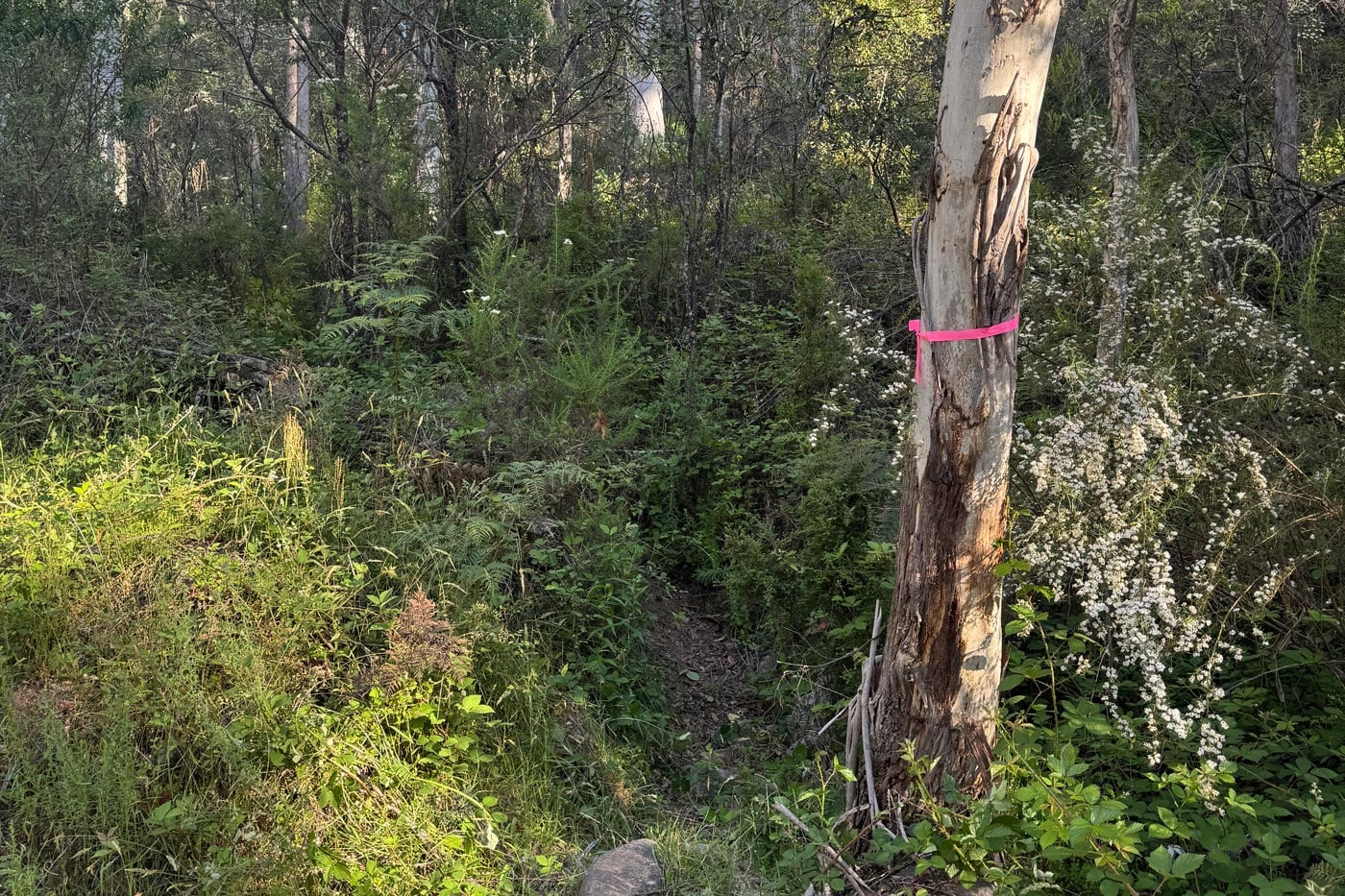
Coloured ribbon and informal marking tape
In many parts of Australia, you may see coloured ribbon or flagging tape tied to trees. Sometimes this is placed by land managers or maintenance crews. At other times, it may be left by bushwalkers marking a personal route, hunters marking an access line, or survey teams working temporarily in the area. Ribbon can be helpful, but it can also be misleading.
There is no universal meaning behind coloured tape unless it is clearly part of an established management system. A single ribbon does not confirm an official trail, and it does not guarantee you are on the correct route. Treat ribbon as a clue, not confirmation.
If it aligns with your map, terrain expectations, and direction of travel, it may support your decision. If it leads away from your planned route or conflicts with terrain features, stop and reassess. Unofficial tape can remain long after the reason it was placed has disappeared. Always confirm with terrain, direction, and known catching features rather than relying on isolated markers.
Adding markers to the bush may seem helpful in the moment, but unofficial tape can remain long after the reason it was placed has disappeared. Over time, this can create confusion, multiple competing pads, and unnecessary impact on vegetation. Before marking a route, consider whether it is truly needed or whether clear navigation and communication are better solutions. Good navigation leaves the landscape unchanged.
When markers disappear
Even on well maintained tracks, there may be long gaps between markers. In remote areas, marking may be minimal by design.
If you have not seen a confirming marker for some time:
- Slow down
- Turn 180 degrees and confirm you can still see the last marker you passed
- Look behind you and study the track from the opposite direction
- Compare terrain features with your map
- Check your direction of travel with a compass or GPS
The 180-degree check is critical. If you cannot see the previous marker, you may already be off line.
Looking back is one of the most powerful relocation techniques in the Australian bush. A track that looks faint when approaching often looks obvious from the opposite direction because of light, flattened grass, or cut branches. If terrain and direction do not align with expectations, treat it as a navigation problem, not a signage problem. If uncertainty increases, apply deliberate relocation strategies rather than continuing forward.
A practical rule
If you have not seen a marker or clear tread for around ten minutes, stop. Do not continue hoping the next marker will appear. The longer you walk without confirmation, the larger the correction becomes. Pause. Confirm direction. Rebuild certainty before moving on.
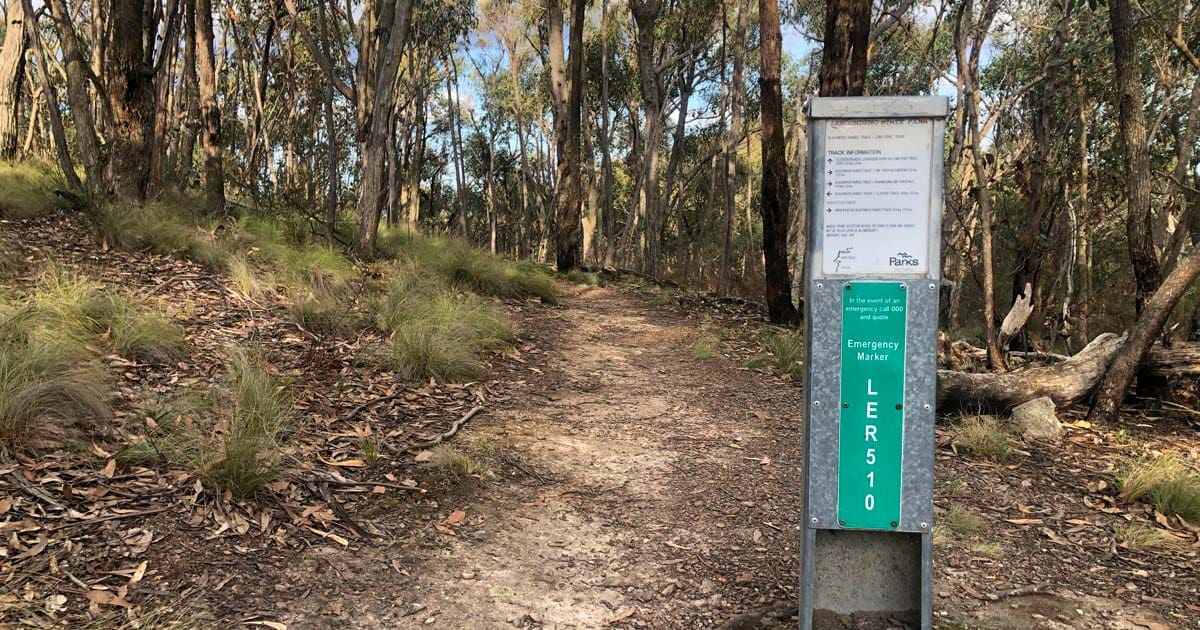
Emergency markers and verifiable location
In some Australian parks and other public open spaces, emergency markers are installed along tracks. These typically display three letters and three numbers, such as LER510. That code identifies a precise, mapped location.
If calling 000, the two most important pieces of information are:
- Where you are
- What has happened
Providing the full emergency marker code allows call takers to verify your location quickly and dispatch resources accurately. Even without mobile reception, an emergency marker remains a verifiable point of reference. If you must move to find signal, being able to say “last known location KNP 100” dramatically improves response accuracy. Emergency markers do not eliminate risk and do not guarantee reception. They are reference tools that support the broader Navigation and Positioning system.
Markers, catching features and confirmation
Markers should not be your only confirmation. A catching feature is a strong, unmistakable terrain feature that confirms your position or stops you if you overshoot. For example, “If I hit the creek, I have gone too far.” Combining markers with catching features, map reading, compass direction and terrain awareness creates layered confirmation. If one layer fails, others remain. That redundancy is what keeps small errors from escalating.
A navigation mindset
Trail markers are helpful. They reduce cognitive load. They provide reassurance.
But strong navigation comes from:
- Reading the terrain
- Understanding ridges, spurs and drainage
- Monitoring elevation and direction
- Confirming progress with catching features
- Noticing when something feels wrong
If you rely entirely on paint, you surrender awareness. If you use markers as confirmation within a broader navigation system, you build resilience.
Clear signage can make hiking feel simple. The bush rarely is. Markers, terrain, maps and your own judgement each do part of the job, and none of them is reliable enough to carry it alone, because each one can fail or mislead you at exactly the point where you need it most. When you understand both the value and the limits of trail markers, you move from following a path to navigating through a landscape. And that difference matters when conditions deteriorate or the obvious line disappears.