Field test and review
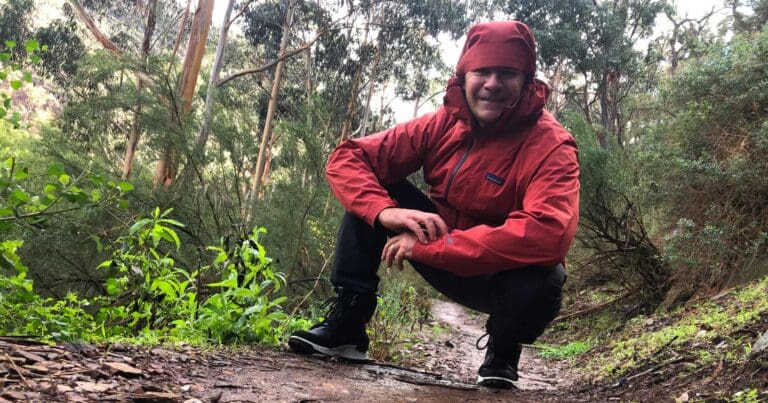
My wife and I did a three day hike recently in Victoria’s South East. Setting off, we thought we might have the trail to ourselves for the weekend, but when we reached camp on the first night we found a much larger group of hikers already there. They were quick to tell us how excellent their navigation was, how experienced they were, and how well they knew the trail ahead, having hiked this very trail one year before. I mentioned that we’d planned our own route using an excellent map of the Northern Prom, checking the trail, campsites, water sources and possible exit points along the way, which seemed to satisfy them that we knew what we were doing.
I always carry a map and compass in my pack, and for hikes around Victoria that map is almost always one of the Outdoor Recreation guides from SV Maps. I use them in every area they cover.
After questioning our navigation skills and equipment, the group’s leader gave us the thumbs up. He felt we were up to the task.
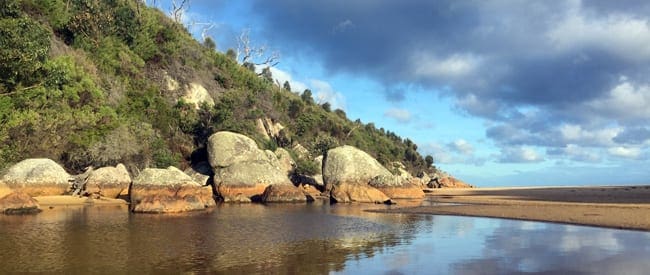
The day ahead was apparently a particularly challenging one for them, all off-trail with bush bashing that needed exceptional navigation skills. They were setting off early because it was a hard stage and they needed to reach the next camp, some 17.4km away, before dusk. We woke at 9:00am to an empty camp and, after casually getting ready, set off at around 10:10am.
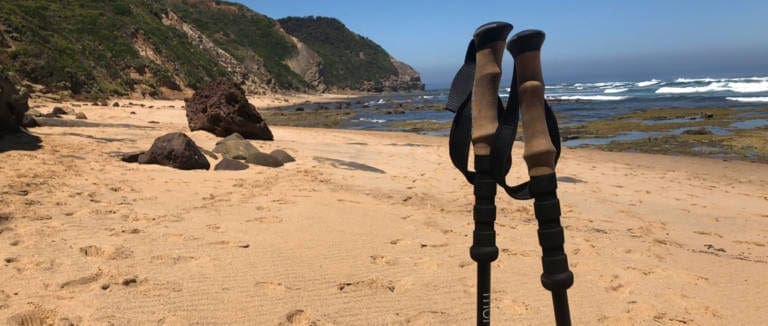
We crossed a few bushy headlands before hitting our first long stretch of beach. It was a little odd that ours were the only footprints on the sand, the whole way along the 5km stretch. When we reached the end of it we stopped for about 40 minutes for lunch, and that’s when a couple of hikers caught up with us. They’d stayed at the same camp the night before and had left about two hours ahead of us, but had gotten lost crossing one of the headlands in the thick undergrowth. They told us the larger ‘experienced’ group had left with them and was still out there somewhere in the bush. We kept half an eye out for them after that.
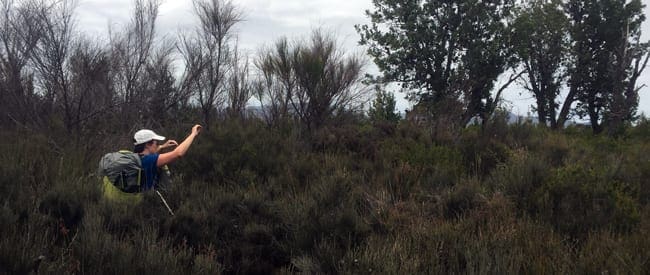
We got to the campsite safely at around 4:00pm, six hours after starting, having covered the 17.4km stage. The experienced group still hadn’t arrived. They eventually turned up at 6:30pm, 10 hours after their journey started.
I asked their group leader what had happened. He said they’d gotten lost, due to the lack of trails, and had struggled through the bush for 3 hours before finding the beach, even though that section should only have involved around 1km of off-trail navigation. He told me there were no trails at all in that section, that they’d had to push through undergrowth over their heads, and could only stay together using whistles.
When we came through that same section, we actually started on a clear trail for about 200m. When the trail vanished, we climbed to the top of the headland to work out our position and checked our map. The distance markers on the SV map meant I didn’t have to measure scaled distances with a compass to see roughly where the next beach picked up, which made the decision easy. Within 30 minutes we were walking on the next beach. Their leader put it down to luck. I didn’t believe luck had much to do with it, rather it was careful planning and navigation that let us proceed without issue, and I have to say I found the arrogance about it quite disturbing.
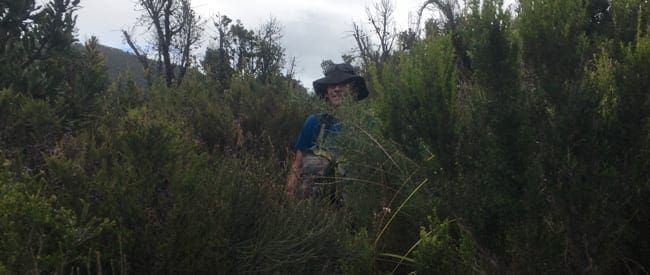
I’m not writing this to undermine that group’s expertise, but to make the point that you should never attempt a hike without proper research, local knowledge, careful planning, a current map, a compass and reliable navigation skills. They made it to camp safely that night, exhausted, but it could have been a great deal worse.
I can say without question that our SV Topographic Map gave us the knowledge and confidence to get it right the first time, rather than spending hours in the bush guessing our way. If I’ve got a genuine criticism of the map itself out of this trip, I can’t point to one. Everything on it, trail, campsites, water sources, exit points, matched what we found on the ground.
Never head out on the trail without the skills and equipment to make it back safely. Know how to read a map and never overestimate your capabilities when heading into remote areas.