Sorry, no records were found. Please adjust your search criteria and try again.
Sorry, unable to load the Maps API.
Explore stunning hiking trails of Coorabakh National Park
Discover the diverse trails of Coorabakh National Park, New South Wales, offering hikes and walks for all skill levels and interests. Find your perfect adventure today.
Discover 1 hiking trail in Coorabakh National Park
Volcanic Peaks and Rainforest Gullies on the Lansdowne Escarpment
Overview
Coorabakh National Park sits on the Lansdowne escarpment, about 22km north of Taree on the Mid North Coast of New South Wales. Though it is relatively compact at 1,840 hectares, it packs a lot into that space, from steep ridges and cliff-lined country to sheltered creeks and pockets of subtropical rainforest. The park is also part of a broader wildlife corridor linking the coast with the Great Dividing Range.
What gives Coorabakh its character is the contrast between elevated lookouts and cool, enclosed creek country. Across the park, the land rises from around 90 metres to 600 metres, creating quick shifts in aspect, vegetation and atmosphere.
Highlights
The defining features here are geological. Coorabakh protects the Lansdowne escarpment, a striking edge above the Manning Valley, along with volcanic plugs known as Big Nellie, Flat Nellie and Little Nellie. These landforms give the park its rugged profile and shape many of its best views.
There is also plenty of variety at ground level. Large overhanging conglomerate formations at Newbys Caves add another layer to the scenery, while the park’s lookouts open onto long views across the Manning Valley and out towards the Bulga and Comboyne plateaus. It is a place where cliffs, rock outcrops and forested slopes all sit close together.
Best Time to Visit
Coorabakh is rewarding in different ways across the year. The cooler months are often the most comfortable for taking in the escarpment lookouts and higher ground, while wetter, warmer periods tend to bring out the lush feel of the creek lines and subtropical rainforest pockets. Because the park ranges from exposed ridges to shaded gullies, conditions can feel quite different within a short distance.
Plants and Animals
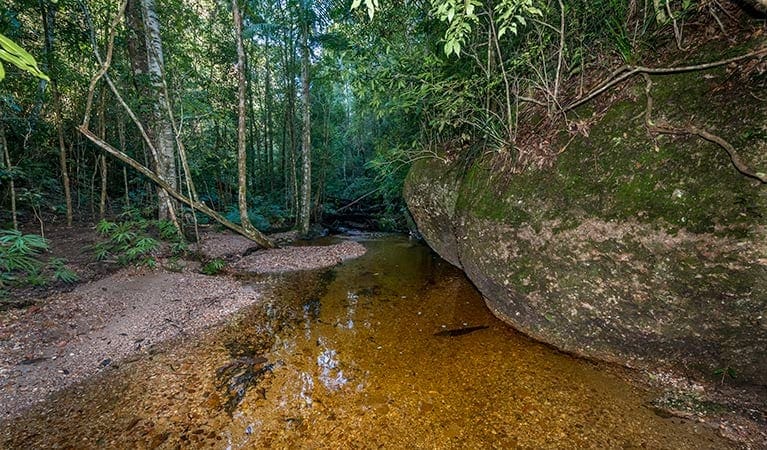
One of the standout things about Coorabakh is how much ecological variety it holds. Eighteen forest ecosystems have been recorded here, ranging from wet foothill blackbutt forest to subtropical rainforest. In sheltered gullies, figs and giant stingers appear, while Starrs Creek supports coachwood rainforest with bangalow palm beneath.
The park is regionally important for rare, threatened and significant plants, including the endangered Hibbertia hexandra, and for the endemic Dracophyllum macranthum. Its fauna is just as notable, with records of threatened species including bush stone-curlew, giant barred frog, spotted-tailed quoll, yellow-bellied glider, powerful owl and stuttering frog.
Culture and Heritage
Coorabakh has ongoing cultural importance for the local Biripi people and is visited for educational and spiritual purposes. The park is managed in consultation with the Biripi people, the Purfleet-Taree Local Aboriginal Land Council and relevant Elders groups.
There is also a strong historical layer tied to the timber industry. Remnants of the old Langley Vale tramway remain in the park, including recorded bridges and cuttings. The tramway began in the 1880s, with the section through the park built in the 1930s, and it is regarded as one of the earliest logging tramways in eastern Australia.
Find more places to explore…
Help expand the trail collection!
Know of an official trail not listed on Trail Hiking Australia? I’m focused on showcasing the best tracks managed by land managers, and I’d love your help! Sharing a trail adds to our community and helps others discover safe, new adventures.
Submit your trail here