Sorry, no records were found. Please adjust your search criteria and try again.
Sorry, unable to load the Maps API.
Explore stunning hiking trails of Monarto Conservation Park
Discover the diverse trails of Monarto Conservation Park, South Australia, offering hikes and walks for all skill levels and interests. Find your perfect adventure today.
Discover 1 hiking trail in Monarto Conservation Park

Where Mallee and Sandy Ridges Meet the Murray Plains
Overview
Monarto Conservation Park sits about 64 kilometres from Adelaide, roughly an hour from the city, in the Murray Plains near Murray Bridge. It protects a pocket of semi-arid country in the rain shadow of the southern Mount Lofty Ranges, with the River Murray about 15 kilometres to the east and Lake Alexandrina about 15 kilometres to the south. That setting gives the park a drier feel than the nearby hills and helps explain why its vegetation and scenery are so different from the country further west.
The landscape is shaped by sandy ridges that hint at an older geological story, when this part of the plains was once connected to an ancient sea bed. Instead of steep relief or big lookouts, Monarto is defined by open, quiet bushland and the subtle textures of mallee, heath and shrub thickets.
Highlights
The character of Monarto Conservation Park comes from its semi-arid Murray Plains setting. Sandy rises and low ridges give the country a gently undulating form, and the vegetation creates a layered look, with mallee woodland, dry heathland, native pines and broombush thickets all contributing to the park’s distinct feel.
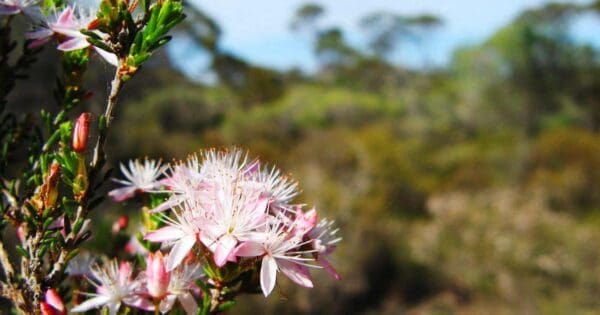
It is the contrast that stands out here. Just beyond the agricultural land and closer to the Mount Lofty Ranges, the park feels noticeably drier, more open and more inland. In spring, blossom on the mallee species adds colour to country that is otherwise shaped by muted greens, silvery foliage and pale sandy soils.
Best Time to Visit
Spring is the standout season. Flowering mallee species are at their best then, and the park’s heathland, native pines and broombush are easier to appreciate when fresh growth and blossom bring more colour into the landscape. Spring is also a particularly good time for noticing fungi, with more than 25 species recorded along the walking track.
Outside spring, Monarto still suits walkers who enjoy quieter, drier country and birdwatching in open mallee habitat. Its semi-arid climate means the park can feel quite different from greener parts of the Adelaide Hills and Mount Lofty Ranges.
Plants and Animals
Monarto protects vegetation communities that are typical of this area before widespread clearing and farming, including mallee woodland, dry heathland, native pines and dense broombush. These habitats support a good range of birdlife, and the park is especially known for species such as southern scrub-robin and heathwren. Other birds recorded here include spotted harrier, purple-gaped honeyeater, spotted pardalote, malleefowl, weebill and white-browed babbler.
The park also supports western grey kangaroos, a native marsupial mouse, bats and ground-dwelling spiders. In the broader Monarto area, the threatened Monarto mintbush occurs in small, scattered populations, adding another layer of botanical interest to this part of South Australia.
Find more places to explore…
Help expand the trail collection!
Know of an official trail not listed on Trail Hiking Australia? I’m focused on showcasing the best tracks managed by land managers, and I’d love your help! Sharing a trail adds to our community and helps others discover safe, new adventures.
Submit your trail here

