Sorry, no records were found. Please adjust your search criteria and try again.
Sorry, unable to load the Maps API.
Explore stunning hiking trails of the Cobaw Conservation Park
Discover the diverse trails of Cobaw Conservation Park, Victoria, offering hikes and walks for all skill levels and interests. Find your perfect adventure today.
Discover 3 hiking trails in Cobaw Conservation Park

Granite Ridges and Woodland Forest Near Lancefield
Overview
Cobaw Conservation Park protects around 2,532 hectares of forested ranges north-west of Lancefield in Victoria’s Macedon Ranges district. Created from the former Cobaw State Forest, the park preserves one of the larger surviving blocks of native forest in a landscape where much of the surrounding country has been cleared for agriculture.
The Cobaw Range forms part of the Great Dividing Range and rises noticeably above the surrounding rural country. Long forested ridges, shallow gullies, rocky slopes and extensive granite outcrops give the park a rugged upland character quite different from the open farmland around Lancefield, Newham and the surrounding district.
That contrast is part of what makes Cobaw important. The park is not simply an isolated patch of bush. The Victorian Government identifies it as an important ecological link between central west Victoria and the eastern highlands, helping maintain habitat connections across a heavily modified landscape.
Highlights
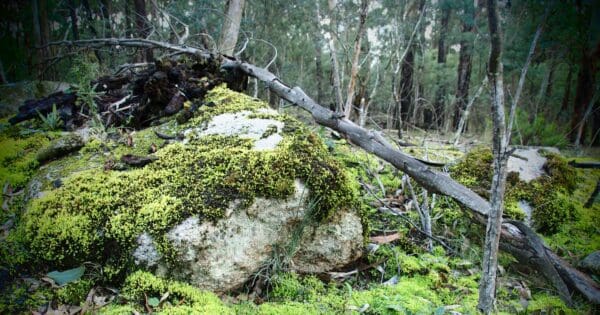
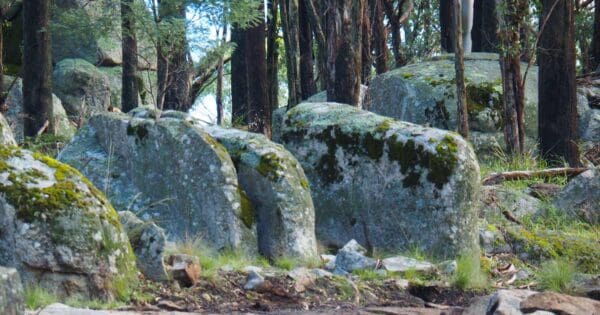
Granite is one of the defining features of Cobaw. The range forms part of a large granitic body, and weathering has left extensive areas of exposed rock, rounded boulders and rocky ridgelines throughout the forest. In places, enormous granite blocks sit among the eucalypts or form prominent outcrops along the higher slopes, giving the landscape a rough and distinctive character.
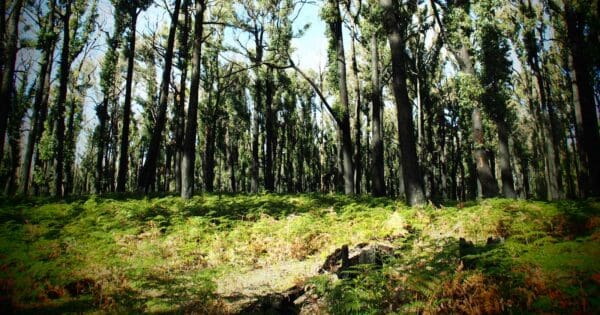
The forest itself changes noticeably as you move across the range. Some ridges are relatively open and dry, with widely spaced eucalypts and bracken beneath, while sheltered slopes and drainage lines can feel cooler and denser. The combination of granite, elevation and forest cover gives Cobaw a strong sense of enclosure despite its proximity to settled country.
Much of the park is crossed by an extensive network of formed roads, four-wheel drive tracks and narrower forest routes. Bushwalking here often involves linking these tracks together into circuits, with quieter sections providing opportunities to explore the granite ridges and less disturbed parts of the forest.
Best Time to Visit
Autumn through spring generally provides the most comfortable conditions for exploring Cobaw Conservation Park. Cooler temperatures suit the exposed ridges and longer circuits, while spring brings fresh growth and flowering plants through the forest.
The granite country can feel quite different depending on the weather. In cool or misty conditions the higher ridges can be damp and atmospheric, while clear days reveal the contrast between the heavily forested range and the open farming country surrounding it.
Summer can be hot and dry, and bushfire risk is an important consideration throughout the park. Visitors should check current weather, fire danger and park conditions before setting out, particularly during prolonged periods of hot or windy weather.
Plants and Animals
Cobaw Conservation Park protects an important remnant of native forest within the Central Victorian Uplands. Messmate is one of the dominant trees across much of the range, with Candlebark and Manna Gum also common. Silver Wattle, Blackwood and Cherry Ballart occur through the understorey, with bracken, tussock grasses and other ground-layer plants changing with moisture and aspect.
The forest is particularly valuable for woodland and forest wildlife because it retains a relatively large area of habitat in a district where native vegetation has been extensively cleared. The Victorian Government specifically identifies Cobaw as habitat for many woodland birds and a number of threatened species.
Recorded mammals include the Agile Antechinus, Brush-tailed Phascogale, Mountain Brush-tailed Possum and Feathertail Glider. A 2017 mammal survey recorded 15 native and introduced mammal species and confirmed the continued presence of the threatened Brush-tailed Phascogale.
Old trees and hollows are particularly important for arboreal mammals and hollow-dependent birds. Granite outcrops also add another habitat type, with cracks, crevices and exposed rock providing shelter for reptiles and other small animals.
Culture and Heritage
Cobaw Conservation Park lies within the Countries of the Taungurung and Wurundjeri Woi Wurrung peoples. The ranges, waterways and surrounding plains form part of a much older Aboriginal cultural landscape that extends beyond the modern park boundary.
European use of the forest brought substantial change. The former Cobaw State Forest was managed for timber and other forest uses over many decades, and the road and track network that remains today reflects much of that working history. Fire has also repeatedly shaped the vegetation, including significant bushfires that have affected the Cobaw Range in recent decades.
Despite that history of disturbance, Cobaw remains an important block of native forest and one of the most distinctive upland landscapes in this part of central Victoria.
A Forested Island in Cleared Country
What stands out most about Cobaw Conservation Park is the way the range rises as a continuous block of forest above the surrounding agricultural landscape. Granite ridges, large boulders, dry woodland and sheltered gullies create a surprisingly rugged setting within easy reach of Melbourne.
Its value extends beyond scenery and recreation. As one of the larger surviving areas of native vegetation in the district, Cobaw provides refuge for threatened wildlife and helps connect habitat between central Victoria and the eastern highlands. The change from Cobaw State Forest to Cobaw Conservation Park recognises that broader conservation role while retaining opportunities for bushwalking, camping and other low-impact recreation.
Find more places to explore…
Help expand the trail collection!
Know of an official trail not listed on Trail Hiking Australia? I’m focused on showcasing the best tracks managed by land managers, and I’d love your help! Sharing a trail adds to our community and helps others discover safe, new adventures.
Submit your trail here